
Apprenticeships have become an invaluable tool for UK businesses, with over 278,000 starts recorded in the 2023/24 academic year alone, according to official Government statistics.
As employers face a growing skills gap and an increasingly digital business landscape, apprenticeships offer a way to equip future generations with the practical skills needed to maintain and grow the industrial sector.
But how exactly are apprenticeships helping to bridge this gap, and what benefits do they bring to businesses?
This post explores the key role apprenticeships play in industrial recruitment and why more companies are embracing this approach.
What is the industrial sector?
The industrial sector typically refers to Manufacturing and Production.
Industries within the sector include automotive, chemical, electronics (technology), machinery, steel, aerospace, textiles and metalworking.
What is an apprenticeship?
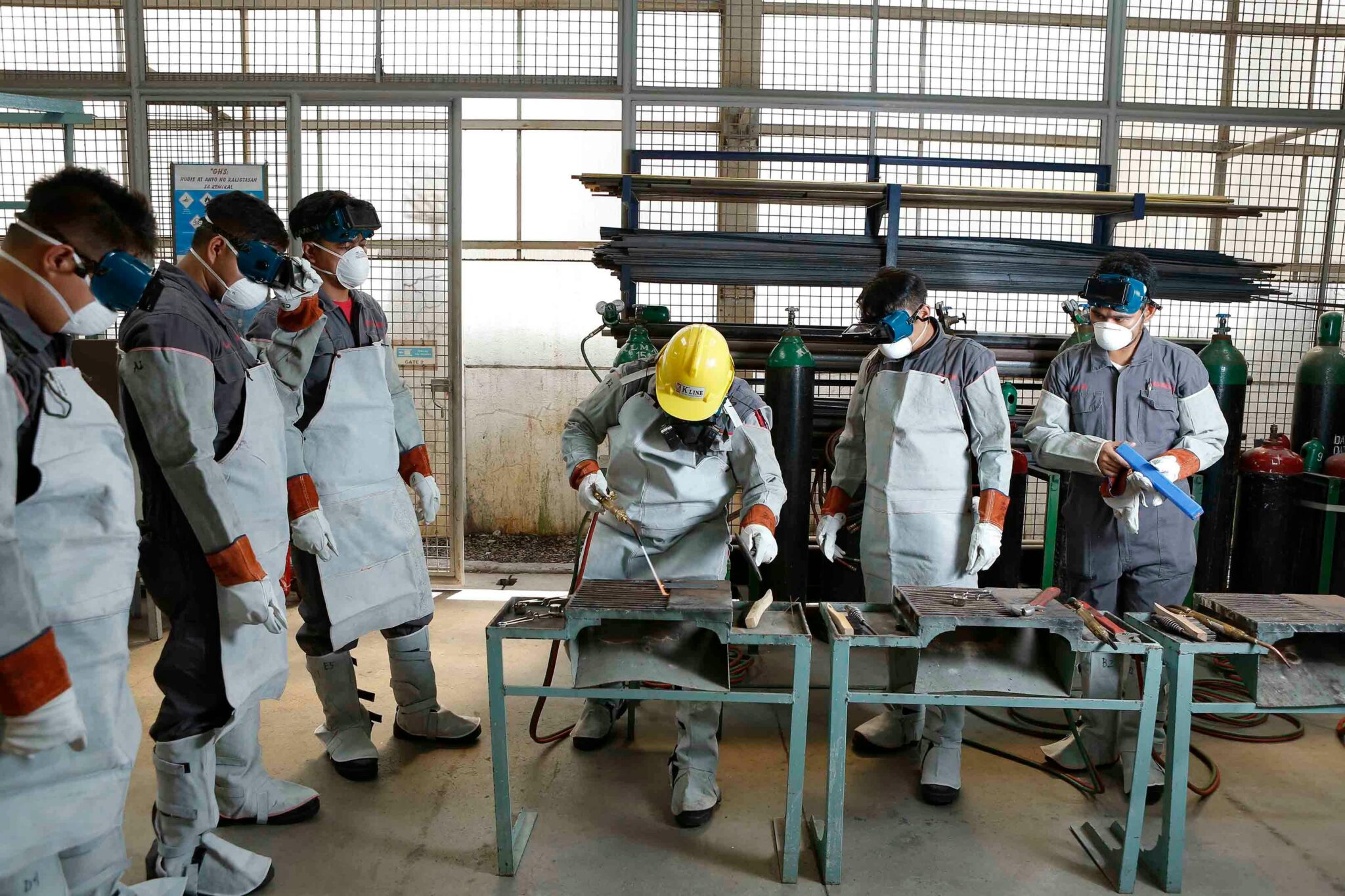
An apprenticeship is essentially a paid, on-the-job training opportunity.
Apprenticeships combine classroom-based learning with a college, university or training provider (typically 20% of working hours) with practical training to learn valuable skills and experience for a specific industry or job.
While ‘at work’, the apprentice will shadow or work alongside a full-time qualified employee or employer to learn their chosen trade through hands-on experience.
Their ‘off-the-job’ training is delivered by subject experts and typically includes theoretical learning, additional practical training, learning support and assessments.
How do apprenticeships work?
There are over 700 types of apprenticeships available across various sectors.
Apprenticeships are coordinated by each individual government (English, Welsh, Scottish), and are typically available for anyone aged 16 or over and not already in full-time education.
Some apprenticeships also have entry requirements, such as specific GCSE qualifications (most commonly Maths and English).
Apprenticeships can take 1-5 years to complete depending on the level.
Apprentices will:
- earn a wage and get holiday pay
- develop the skills needed for the job
- work on the job for around 80% of the apprenticeship
- get time for study related to the role, either at their place of work, a college, a training provider or online
- be on a career path with lots of future potential
Learners will also earn a qualification from your apprenticeship. The 4 different apprenticeship qualifications levels are:
- intermediate: level 2 (equivalent to a GCSE)
- advanced: level 3 (equivalent to an A Level)
- higher: level 4 or 5 (equivalent to a foundation degree)
- degree: level 6 or 7 (equivalent to a Bachelor’s or Master’s degree)
How apprenticeships are helping bridge the skills gap in the industrial sector
Before we dive into the role of apprenticeships in tackling the skills gap within the industrial sector, it’s important we understand exactly what the skills gap is and how it’s impacting businesses.
What is the ‘skills gap’?
The skills gap refers to the difference between the skills an employer needs employees to have in order for the company to perform to its full potential and the actual skills their employees possess.
Why is there a skills gap?
The skills gap in the industrial sector, especially, isn’t caused by a singular problem.
Instead, a combination of increased and rapid digitalisation, a lack of digital skills in older working generations, declining birth rates, and inadequate education in schools.
Rapid digitalisation
The digital revolution began in the 1980s with the birth of the internet, developed further with the invention of mobile devices, social networking, big data, cloud computing and so on.
The digital landscape changed drastically at the start of the 21st century, putting strain on millions of businesses to adopt digital strategies and adapt to a changing consumer landscape.
We then saw another drastic shift as a result of the COVID-19 pandemic, which provided a make or break business landscape, with those embracing digitalisation coming out on top.
Lack of digital skills
While the digital revolution drove change in many businesses, it highlighted a significant skills gap in older working generations.
Those who have been in the workplace for decades already are typically more reluctant to embrace changes, particularly those related to the digital revolution.
As a result, the current workforce, while having practical skills required to do their job, often don’t have the digital skills required to support their employer in a rapidly changing environment.
Declining birth rates
In addition to the lack of digital skills within the existing workforce, UK birth rates have dropped and are expected to continue declining in the coming years.
2023 data from the Office of National Statistics shows that there were 591,072 live births in England in Wales last year, the lowest since 1977.
Meanwhile, data from the UN shows that births per 1000 people in the UK are lower now than they were 20 years ago, with 13.094 births per 1000 people in 1994, compared to 11.267 in 2024.
As a result, the youngest generations entering the workforce are considerably smaller than those approaching retirement age. This means the workforce as a whole will be much smaller in coming years, which will not only have a significant impact on the ability for employers to keep up with the changing business landscape, but will also mean the level of experience and expertise in the industrial sector will also be significantly lower.
Inadequate education
Quite simply, the focus on academic knowledge in UK schools has meant practical skills have taken a back seat since an overhaul in the National Curriculum in 2014.
Unfortunately, this focus on academics has meant we, as a nation, are unable to affectively fill positions in vocational and practical industries, further impacting the skills gap.
How do apprenticeships bridge the skills gap?
The role of apprenticeships in the UK is a vital one.
In providing vocational opportunities through paid apprenticeships allows our next generations of workers to gain qualifications, earn a wage and gain the exact skills they need to succeed in their chosen industry.
In being taught by subject experts, apprentices are able to learn best practice skills and techniques for their industry or role, not only providing them with an easier route into employment post-apprenticeship, but also training up the next generation of teachers to help pass these skills down to future generations.

What are the benefits of apprenticeships for businesses?
Of course, apprenticeships don’t just benefit the apprentices. The UK government recognises the value of apprenticeships in the battle to close the skills gap and encourage economic growth.
So, there are a number of incentives in place for businesses who take part in the scheme:
- Reduced recruitment costs – Apprenticeships provide businesses with the opportunity to recruit and train talent in-house at a lower cost to recruiting externally.
- Diversification – Apprentices help to diversify the workforce, contributing new ideas, perspectives and innovation opportunities to established practices.
- Improved talent acquisition – Apprenticeships create a streamlined talent pipeline, with the outcome of acquiring employees with the exact skills they need and familiarity of their operations and values.
- Closing the skills gap – By offering targeted training, businesses provide apprentices with the skills needed for their specific industry, helping to close the skills gap within their own team.
- Increased retention rates and employee satisfaction – Investing in employee development often leads to higher engagement. Apprentices will often stay with the company post-training, boosting overall retention and employee confidence.
- Continuation and development of industry-leading skills and practices – Apprenticeships mould the next generation of experts, ensuring industry-specific skills are passed down and expanded on.
- Government incentives – Financial support and grants available through government programs help reduce costs associated with training apprentices, making it more economically viable for businesses to participate.
So, what is the role of apprenticeships in industrial recruitment?
Apprenticeships play a significant role in the transformation of the industrial sector by bridging the skills gap, which has grown exponentially with rapid digitalisation in recent decades.

Through hands-on training and a structured educational path, apprenticeships provide both practical skills and theoretical knowledge, making apprentices job-ready and immediately beneficial to employers.
By investing in apprenticeships, industrial businesses not only gain a direct pipeline to skilled talent but also contribute to sustainability, innovation and growth within their field.
Ultimately, apprenticeships are a crucial tool for industrial recruitment, helping to ensure that businesses stay competitive, agile, and prepared for the future.


